
My biggest mistake was building a digital product before I even checked if people would actually pay for it.
Whoopsie 🫣
And I did that more than once. You know, just in case it would work hehe.
But it didn’t.
Have you done the same?
That’s why I’ll show you how to do market research for a product that will actually sell.
Doing this research is important if you want to avoid the painful “Why didn’t anyone buy?!” situation.

This post contains affiliate links (including Amazon Associate links). If you make a purchase through these links, I may earn a small commission at no extra cost to you. As an Amazon Associate, I earn from qualifying purchases. Please read full disclosure for more information. I also use AI to help me write, but I tell it exactly what to say based on my results and experiences.
Why creators keep building products nobody buys
I’ve talked with many creators over the past 7+ years and noticed that either they completely skip market research or do it wrong.
Skipping it will only cause you to waste your time and keep your piggy bank skinny.
Now, if you do the research wrong, you’re actually finding pain points that are not urgent for people to solve.
Someone saying, “Yeah, I should probably figure that out at some point,” is not in the buying mode.
They’re not hurting enough to open their wallet yet. That’s why you need to do market research carefully.
Join other action takers and get the plan to see how these phases work together, so your hard work finally pays off.
What market research actually means for a digital product
Market research means you find the exact words your audience uses when they’re irritated about a problem.
You don’t guess what’s inside their head. Instead, you look for the specific complaints they type online when they want a fast solution.
Before you make any digital products, you use those exact same complaints to structure your offer. You’re just finding the problem first, so you know your product will sell.
How to do market research for a product the right way
You need to go where your audience already complains about their problems – ONLINE.
You’re not making up their struggles. You’re not brainstorming in a Google doc at midnight with a cup of coffee and your best guesses.
You’re reading what people have already said on forums, in Facebook groups, and in comment sections.
And you need to see the same problem come up again and again across different people.
One person complaining once doesn’t mean anything. But if you see 10 people on different platforms all saying the same thing, that’s your product idea.
The real places to find what your audience is struggling with
You’ll find the best research in the places where people already talk honestly. Here’s where to look:
- Facebook groups in your niche, especially posts that get a lot of replies
- Reddit threads where people vent, ask for help, or explain what they already tried
- Comment sections under competitor content and YouTube videos in your space
- Etsy, Gumroad, and Payhip reviews for similar products, especially the 3 and 4-star ones
- “People Also Ask” boxes in Google when you search your main topic
But this will take you some time, so be patient.
I was exhausted from doing all of this manually. It took me a week or even longer.
So I built an AI workflow that does it all in 15 minutes.
And when I used it for the first time, guess what the number one problem it found was?
It was product research. I started giggling because I’d literally just built a workflow for the problem we all have.
So now you don’t have to waste a whole week doing this the hard way anymore. You don’t have to guess what people want or feel stuck, wondering if your product will even sell.
You can just skip all that manual work and get a winning idea in 15 minutes with The Research Kit To Stop Creating Digital Products Nobody Buys.
How to recognize a pain point that’s actually worth building around
You know you found a pain point worth building around when people just can’t stop talking about it. They want to fix it right now because the problem is driving them crazy.
If you see 15 different people complaining about the exact same thing on different platforms, you have found a real problem.
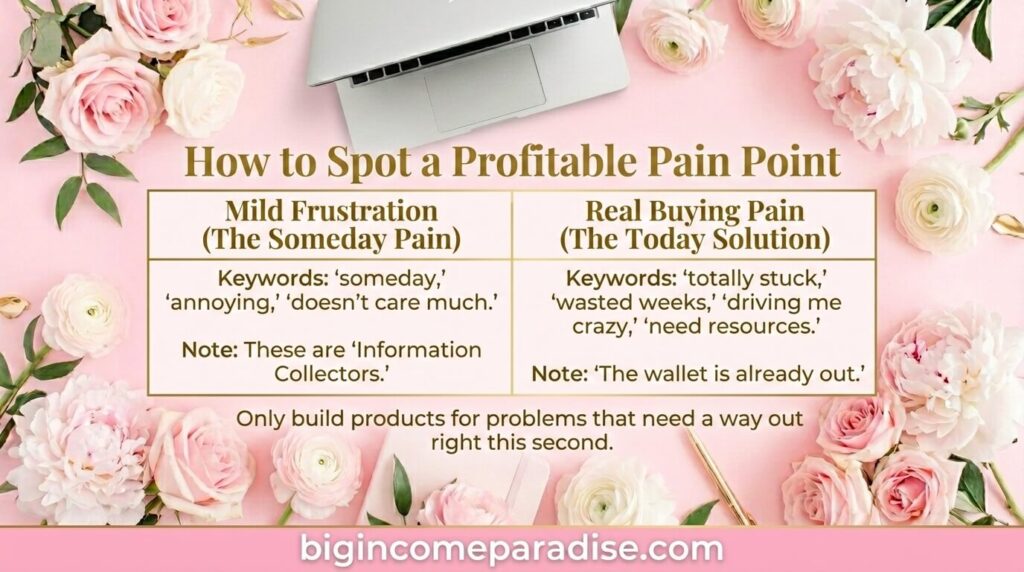
But you also need to notice the words they use. Real buying pain sounds like they are totally stuck.
They say they wasted weeks trying to fix it. They ask if anyone knows about good resources that would help them. That means they already have their wallet out.
Mild frustration sounds totally different. They usually say they’ll look into it someday. Those people aren’t going to buy anything from you yet.
Here is an easy way to think about it:
- Real pain means they need a way out right this second.
- Mild frustration just means it is annoying, but they don’t care that much.
You only want to build things for the first kind of problem.
How to know your research is done and you’re actually ready to build
You’re ready to build when you can answer these 3 questions without guessing:
- Who is this product for?
- What exact problem does it solve?
- What does the buyer walk away with?
If you can answer all 3, you’re ready. But if one of them is still fuzzy, your research isn’t done yet.
What makes a product idea actually worth building
You found a real problem during your research. Now you need to check if it’s specific enough to become a product.
Here’s what you should focus on:
- Your digital product solves ONE problem for a specific audience
- The customer can follow a simple process and get a win in the first week.
- They can picture exactly what they’ll have when they’re done
- The audience is already paying for solutions in this space
- The pain is urgent, not just mildly annoying
One more thing worth checking: how many similar products already exist.
Search on Etsy, Gumroad, Payhip, and competitors’ stores. If you find at least 5-10 similar products, it’s actually a great sign. It means the demand is there.
Is there already too much competition for your product idea?
Finding 5-10 similar products is actually good news.
It means people are already buying things like what you want to build. That’s demand.
You just need to position yours in a way that fills the gap the others left open.
Finding zero similar products might feel like you won the jackpot, but it’s usually not.
It often means nobody is searching for a solution to that problem. Maybe the problem isn’t urgent enough to pay for.
And finding hundreds of similar products at super low prices? That’s the market telling you to find a more specific angle before you create anything.
The sweet spot is 5-15 similar products. Enough to prove demand.
What your product planning should look like after the research
Your product planning should look like a simple one-page profile that maps out the details of your offer. You should know the format, price, and the precise transformation your customer will get.
Here’s the exact breakdown you need to fill out before you start creating:
- Product idea: The specific thing you’re building to fix the main issue.
- What format it should be: The type of file or delivery, like a template, PDF, mini-course, etc.
- Why this format fits: The reason this style helps your buyer consume it with ease.
- Price range: The low-ticket cost that your audience can spend without hesitation.
- Transformation: The clear result they’ll see right after they use it.
- The unique angle: How your offer fixes the problem differently than what’s already out there.
- The pain it solves: The specific frustration that is driving your audience crazy.
- The name of the product: A clear title that tells people exactly what they’re getting.
- All the objections + the statements that would crush those objections: The doubts your buyers have and the honest answers that prove your product works anyway.
You can get all this in 15 minutes with The Research Kit To Stop Creating Digital Products Nobody Buys.
Final thoughts
You need to know how to do market research for a product before you open Canva.
Finding the real pain helps you build something highly specific. When your offer fits perfectly, your ideal buyer will read your title and know it is for them.
You don’t have to waste a whole week doing this the hard way or guessing what people want. You can be done in 15 minutes.
If you are ready to stop wondering if your products will sell, The Research Kit To Stop Creating Digital Products Nobody Buys is right here.


 Petra is a full-time blogger and CEO of Big Income Paradise. She teaches digital creators how to get more Pinterest traffic, generate leads, create better content & digital products, and make money online with the help of AI.
