
Your digital product is good. But you still can’t figure out why more people aren’t buying.
I used to think that was a traffic problem. So I’d go fix my traffic with Pinterest.
Then I thought it was a pricing problem…and I lowered my price.
I’d also go back and tweak my offer for the 5th time.
But none of that fixed it. The real problem was somewhere else entirely.
The reason buyers click away from a digital product they actually need is almost always psychological.
So once you understand the marketing psychology for digital product creators, you’ll know exactly what to fix.
TL;DR:
– Marketing psychology is the study of how buyers decide to trust something and buy it.
– For digital product creators, it covers trust signals, pricing perception, conversion triggers, and what keeps customers coming back.
– Understanding it is what separates a product that sells from one that just sits there.
This post contains affiliate links (including Amazon Associate links). If you make a purchase through these links, I may earn a small commission at no extra cost to you. As an Amazon Associate, I earn from qualifying purchases. Please read full disclosure for more information. I also use AI to help me write, but I tell it exactly what to say based on my results and experiences.
What is marketing psychology?
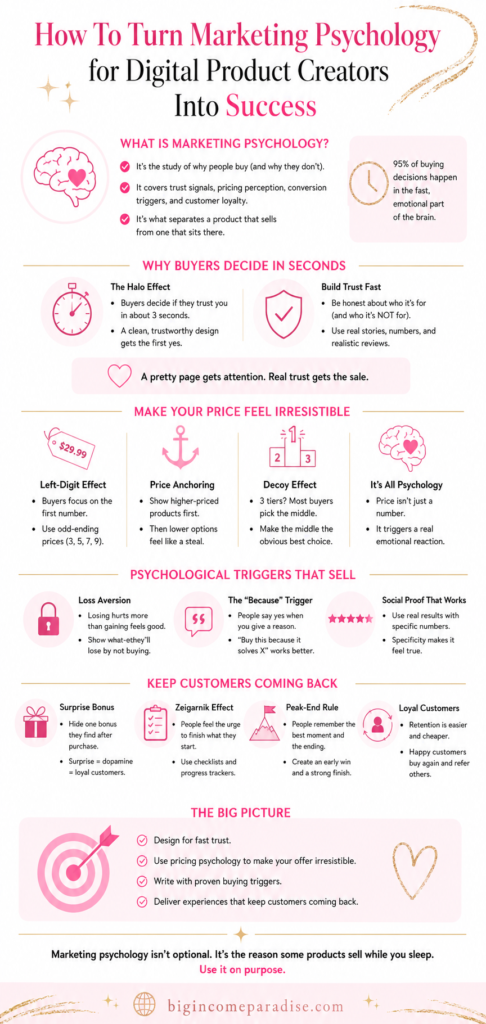
Marketing psychology is the study of why people buy. And more importantly, why they don’t.
You don’t need tricks or manipulation for this. But you do need to understand how the human brain actually makes decisions.
That way, you stop accidentally working against it.
About 95% of buying decisions happen in the fast, emotional part of the brain. That’s the part that runs on gut feeling and habit.
The slow, logical part shows up later, after the purchase. It just explains a decision that was already made.
Your customer isn’t reading every word on your sales page and weighing pros and cons. They’re scanning for reasons to trust you. And that happens fast…in just a few seconds.
I wasted years writing sales pages for the careful, logical reader. And you can imagine it didn’t go so well.
Once I stopped writing for them and started writing for how brains actually work, my sales pages started converting better.
Marketing psychology for digital product creators isn’t a “maybe later” thing. It’s what separates a product that sells while you sleep from the one you have to keep pushing.
Why your buyer decides in seconds (and what to do about it)
Your buyer looks at your sales page and decides if they trust you in about 3 seconds. Yup, you read that right. That fast judgment is called the Halo Effect.
If your page looks clean and trustworthy, your buyer’s brain assumes everything else about you matches that quality.
The design is the first signal your buyer’s brain uses to decide if you’re worth listening to.
But a pretty sales page alone doesn’t make someone buy. And I can tell you that from my own experience.
I had multiple failed launches where my pages looked great. The colors were nice, the fonts matched, and there was enough space. But nobody was buying.
I kept tweaking the design, thinking that was the problem.
The real problem was that I wasn’t giving people other reasons to trust me.
I wasn’t telling my story and giving real numbers from my own results. I also made it very confusing who my product was for.
So at first glance, my page looked trustworthy, but the words on it didn’t back that up.
Look, a clean sales page can get a good first impression. But real stories, numbers, and honest opinions are what make them actually trust you enough to buy.
Here’s what builds trust faster
Tell people where your product WON’T work. Say something like “this works best if you already have an audience, but it’s probably not right for total beginners.”
That does two things:
- It makes you sound honest
- And it filters out the people who would’ve probably asked for a refund
A bunch of perfect 5-star reviews can actually hurt your sales. I read a study that found purchase likelihood drops when ratings go above 4.5 stars.
It’s better to include the slightly critical ones too, so it looks real. That will build trust way faster.
If your conversions are low, check trust first. A great buying trigger won’t do anything if your buyer doesn’t trust you yet.
Join other action takers and get the plan to see how these phases work together, so your hard work finally pays off.
How your price feels to your buyer’s brain
Your price isn’t just a random number on a page. It actually triggers a real emotional reaction inside your buyer’s brain.
The way you display your numbers changes how expensive an item feels.
When you understand how people process math, you can easily tweak your prices to make your digital products look irresistible. Let me show you some hacks.
The left-digit effect and odd-number pricing
The left-digit effect means buyers look closely at the first number (or first two) they see. When someone looks at $29.99, their mind instantly focuses on the 29.
Even though there’s only one cent to price being $30, they still see it as $29.
You don’t need to use .99 cents at the end of every single offer, though.
I actually saw a slight increase in my sales when I just focused on clean numbers like $27, $97, etc. But I always end the price with an odd number (3, 5, 7, 9).
Price anchoring
Most digital creators put their lowest-priced products first because they’re scared of leading with a bigger number.
But price anchoring works backwards. Let me explain it with an example:
If you show someone a $297 product first, then the $47 option – the second one feels inexpensive and more people will buy it.
I set up my store this way now. I first show two higher-priced products, then a low-ticket one.
The decoy effect
If you have 3 pricing tiers, most buyers choose in the middle. You can use that on purpose.
Design your tiers so the middle one is the one you want people to choose. Here’s how:
- Make the cheapest option limited enough that it doesn’t fully fix the problem
- Make the most expensive one priced high enough that the middle one feels like the smartest option
This is how you get people to buy the middle option. Simple, isn’t it?
The psychological triggers that get people to buy
These kept showing up in the psychology of marketing research. They work because they’re based on how people actually decide things.
Loss aversion
Losing something hurts MORE than gaining the same thing feels good. That’s straight from behavioral science research on loss aversion.
I’ve heard many people say they don’t want to press on their audience’s pain. But let me explain why that’s not a smart decision.
Most digital creators only focus on what the buyer will gain: “Get more Pinterest traffic,” “Grow your email list,” etc. That’s totally fine.
But highlighting what they’re still losing by not buying will make them feel the emotions more. For example:
- “Your traffic’s been the same for 6 months while other creators who figured this out are already way ahead” gets inside your buyer’s head way more than “get more traffic” ever will.
You don’t need to be dramatic and overdo it. Just one clear sentence here and there that shows what not buying is actually costing them is often enough.
The “because” trigger
I’ve been reading the book Influence: The Psychology of Persuasion by Robert Cialdini. Inside, he talks about an interesting experiment.
Social psychologist Ellen Langer asked a small favor of people waiting in line to use a library copying machine.
She found that 94% of people let her skip ahead when she provided a reason. The reason was “because I’m in a rush.”
But when she asked without using the word “because,” only 60% let her skip ahead.
And yes, this works online too. For example:
“Buy this” converts worse than “buy this because it gives you the exact system for the part most creators get stuck on.”
You can add a specific reason to your CTA. But a vague benefit won’t do it. You need a specific one.
Social proof with real numbers
“Join 10,000 customers” doesn’t work well anymore. We’ve all seen it a million times. Plus, people can just make the number up.
Specific proof with REAL RESULTS is what actually works way better.
A review that says “I sold my first digital product 48 hours after going through this guide” gives your customers’ brains something real to hold onto.
So remember, specificity makes it feel true. And a vague “I loved it!” does basically nothing.
How to keep customers coming back
Getting the first sale is the hard part. Keeping a customer after that is way cheaper and way easier. And the marketing psychology gives you the tools to do both.
The “Surprise Bonus” Hack
This is the most powerful way to make someone LOVE your digital products. If your customer finds a secret bonus inside, their brain releases a huge burst of dopamine.
So don’t put all your bonuses on the sales page. Keep one small, cool bonus as a “surprise” they only find after they purchase and log in.
I did that only once and got a great reaction. I’ll start doing this for all my products.
This “over-delivering” makes the customers’ brains want to come back for more.
The Zeigarnik effect
People feel pulled to finish things they’ve already started. If you put a checklist or a progress tracker inside your product, that pull stays in your buyer’s head.
They feel a little uncomfortable leaving it unfinished. That’s a good thing because it brings them back.
One small trick that works really well: pre-check the first item on your checklist. Something like “Product downloaded” is already ticked off.
Their buyer immediately feels like they started.
I know it sounds too simple to work, but it does. Our brains are wired that way.
The peak-end rule
People don’t remember experiences evenly. They remember 2 moments: the best part, and the very end. Everything in between gets blurred.
For digital products, you need at least one strong early win and a good finish. Let me explain:
- A quick result in the first section of your product is the peak.
- A certificate, a clear “you finished it” moment, or a strong next step is the end.
Build those 2 moments on purpose. They affect your reviews, your referrals, and how much of your sales come from people who have already bought from you once.
How do successful digital product creators use marketing psychology to increase conversions?
They use it at every stage:
– They design for fast first impressions using the Halo Effect
– Use price anchoring so their main offer feels like an obvious yes
– Write CTAs around loss aversion
– And build real win moments inside the product so customers want to come back.
What psychological triggers boost digital product sales conversions?
The 3 that matter most are loss aversion, the “because” trigger, and social proof with real specifics. Loss aversion refers to what your buyer keeps losing by not taking action now. The “because” trigger gives the brain a real reason to say yes. Specific social proof with actual results makes your proof feel credible.
Which marketing psychology techniques boost customer trust in online products?
You can boost trust by showing real numbers and reviews because our brains love to follow what other happy people are doing. It also helps to be super honest and tell people exactly when your product WON’T work. Giving a “surprise bonus” that you didn’t even promise makes their brains feel happy and want to come back for more.
Conclusion
Marketing psychology for digital product creators isn’t something you add to your business later. It’s already happening on every sales page you have.
The only question is whether you’re doing it on purpose or just winging it.
Fix trust first, then your pricing or other buying triggers. You don’t need to redo everything today.
Pick the 1 thing from this post that felt like “oh, that’s why that wasn’t working” and start there.
But all of this psychology only works if you actually have a finished product to put it on. If yours is still sitting in a Google Doc somewhere, the Prompt-to-Profit System is the next step.
It walks you through building your digital product and the sales system around it in 7 days, one task per day. You follow the steps, and you finish. It’s that simple.

 Petra is a full-time blogger and CEO of Big Income Paradise. She teaches digital creators how to get more Pinterest traffic, generate leads, create better content & digital products, and make money online with the help of AI.
